
The Consequences of Proximity to Power
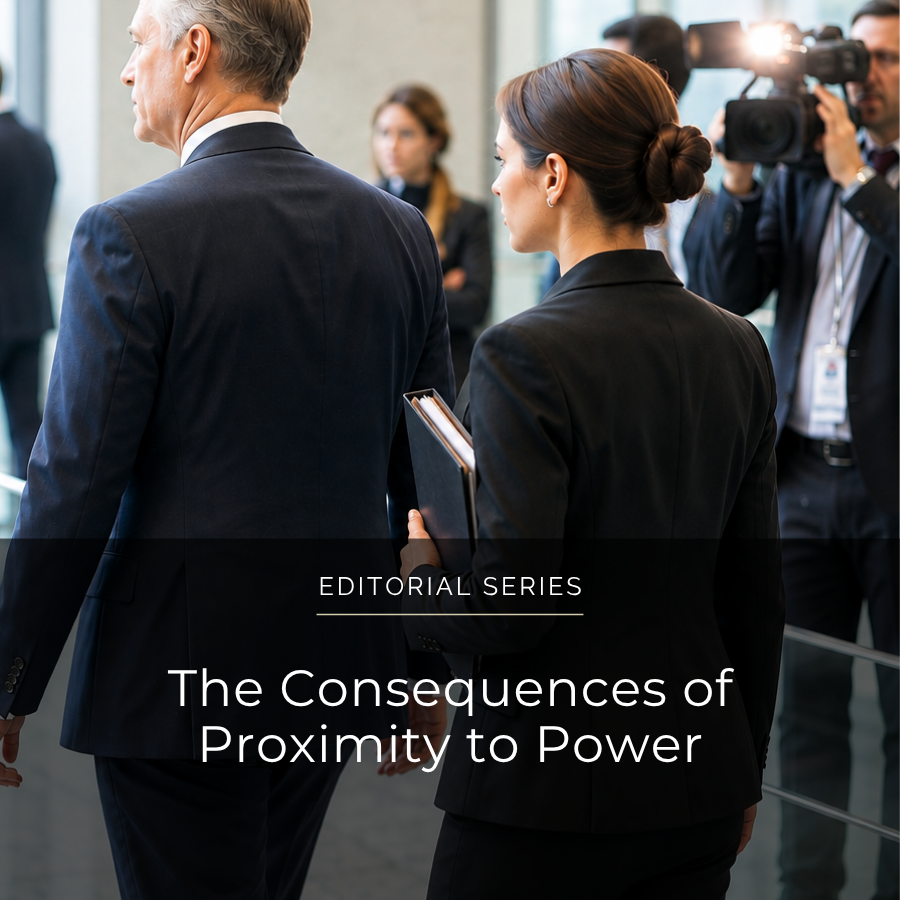
There is something unusual about the relationship between an Executive and the Assistant who supports them.
They can spend an extraordinary amount of time together, often working at speed and with access to conversations, information and situations that few others see. Over time, trust builds, context accumulates and the strongest relationships develop an understanding that can be difficult for anyone outside them to fully appreciate.
That proximity is part of what makes the relationship work. But it also has consequences.
An Assistant may technically report through another function, or sit one or two levels below the Executive on an organizational chart, while in reality operating more closely with them than people in considerably more senior positions. Others notice.
They notice who gets access, who can interrupt, who travels, who is included in conversations and who seems to know what is happening before everyone else does. Proximity can become a form of organizational status, whether the Assistant intends it to or not.
And that proximity can be contested.
Executive access is limited. Senior leaders, colleagues, clients, board members and others are all competing, in different ways, for the Executive's time and attention. Attempts to bypass the Assistant, pressure for access or assumptions about how much influence they have will be familiar to many experienced EAs.
Sometimes even the reporting line doesn't reflect the reality. An EA may not formally report to the Executive at all, yet fiercely protect the proximity that allows the partnership to work. The Executive may value that closeness just as highly, without seeing the relationship as something that needs to be protected in the same way.
That distinction matters. What the Assistant experiences as a tightly held partnership may, from the Executive's perspective, simply be a highly effective working relationship.
Neither makes the relationship less valuable. But it is an important distinction when so much of the Assistant's effectiveness has been built through accumulated context, observation and trust.
When proximity changes perspective
There can also be something intoxicating about being that close to power.
Your calls are returned. You have information others don't. You can reach someone most people cannot. You may be sitting in rooms that your position on paper would never suggest you should be in.
Not everyone handles that well.
For some Assistants, access can begin to feel like authority. The Executive's status starts to feel, however subtly, transferable.
It isn't.
But there is an equally difficult position at the other extreme.
An Assistant can become so focused on process, boundaries and doing things the “right” way that they become an obstacle to the Executive they support.
Highly successful people often move quickly. They use relationships, make the direct call, skip unnecessary layers and find the path with the least friction. Sometimes things simply need to get done faster than the usual process allows.
That doesn't necessarily mean anything improper is happening. It does mean the Assistant needs to be very good at knowing the difference.
Is this a shortcut that removes unnecessary friction, or one that removes an important safeguard? Is discretion appropriate here, or are you being asked to conceal something? Is this simply an unconventional way of getting something done, or is there a reason to stop and question it?
Push back on everything and the relationship may not last. Never push back and you risk being carried along by someone else's momentum without considering where your own responsibility begins and ends.
That is a much more complicated professional skill than simply becoming a “trusted partner.”
Proximity also creates exposure
This becomes particularly important for an Executive Assistant, personal aide or private assistant supporting a high-profile individual.
The very things that can make an Assistant exceptionally valuable - access, institutional memory, confidential information, knowledge of relationships, visibility over movements and meetings, and proximity to decision-making - can also create exposure.
Most of the time, nobody outside the immediate environment knows who that person is.
The public sees the president of an organization, CEO, founder or other prominent individual. It rarely sees the small professional ecosystem enabling, protecting and managing the activity around them. Until something goes wrong.
When a high-profile individual comes under scrutiny, attention can move quickly outward to the people closest to them.
Who knew? Who arranged the meeting? Who controlled the diary? Who handled the correspondence, social media? Who was present? Who had access? Who was in the room?
Suddenly, an Assistant whose professional effectiveness has partly depended on discretion and invisibility can become interesting precisely because of how close they were. This is proximity risk.
Proximity does not establish authority, involvement or culpability. But outsiders examining a tightly held executive ecosystem may not initially make those distinctions. They see access and can infer influence.
The Assistant can be almost invisible while the relationship operates outside public scrutiny - and extraordinarily visible once attention turns to the person they support.
Understanding what comes with the access
We talk a great deal in executive support about becoming a trusted partner, gaining access, becoming indispensable and getting closer to decision-making. We talk much less about what happens once you get there.
Proximity can bring trust, access and organizational standing. It can also attract competition, alter perspective and create exposure. Handling it requires more than discretion. It requires the ability to read context, understand competing interests, operate at executive speed and remain very clear about your own position within the system.
This is part of what we mean at The Global Assistant when we talk about strategic influence. Influence is not simply about how much access you have. It is about understanding the environment in which that access operates and knowing how to navigate it.
Because the real test isn't whether an Assistant can get close to power.
It's whether they understand the consequences of being there.