
2026: Where to Position Your Executive Support Role for the Future
At the start of 2026, many executive support professionals are carrying a feeling that’s hard to name.
It isn’t anxiety about capability. Most people in executive support know they can handle complexity, pressure, and pace. They’ve been doing that for years. What feels unsettled is something else entirely: a sense that the role is becoming harder to read from the outside, even as it becomes more important on the inside.
There’s a quiet disconnect opening up between the contribution executive support professionals are making and the language organisations still use to describe that contribution. And 2026 is shaping up to be the year when that gap becomes impossible to ignore.
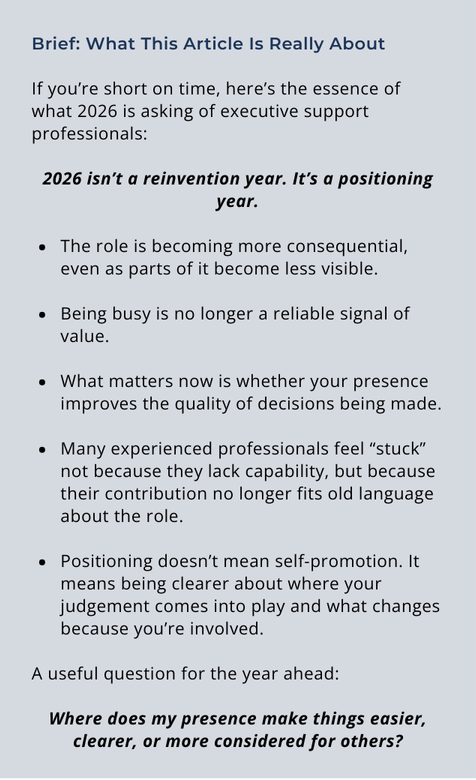
This isn’t a year for reinvention. It’s a year for positioning.
Why 2026 Feels Different
Nothing dramatic has “changed” overnight. There’s been no single moment where the rules shifted. Instead, 2026 arrives as a continuation of several forces that have been building for some time: ongoing economic pressure, constant technological adjustment, leadership churn, and organisations asking for adaptability while offering very little clarity in return.
For executive support professionals, this creates a particular kind of tension. The work is becoming more consequential. Decisions carry more risk. Timing matters more. Context matters more. And yet, much of that contribution happens quietly, without obvious outputs or neat metrics.
In earlier years, being busy was enough. Responsiveness, volume, and availability were visible signals of value. If you were constantly in demand, constantly switching tasks, constantly “on”, your contribution was assumed.
That assumption is no longer reliable.
When Being Busy Stops Working in Your Favour
Many executive support professionals have noticed that working harder doesn’t land the way it once did. Faster responses don’t necessarily translate into greater trust. Taking on more doesn’t always lead to greater recognition.
Part of this is structural. Automation has absorbed a portion of execution-heavy work. Leaders are filtering information more aggressively. Decision-making cycles are shorter, and tolerance for noise is lower. In that environment, volume can start to look like clutter rather than value.
What increasingly matters is whether your presence improves the quality of decisions being made. Not visibly. Not loudly. But materially.
That kind of contribution is harder to point to. It doesn’t show up in task lists or dashboards. It shows up in moments where something doesn’t escalate, where a poor decision is avoided, where timing is adjusted just enough to change an outcome.
These are the moments executive support professionals are often closest to — and least likely to articulate.
What Leaders Are Actually Leaning On
Inside organisations, leaders are navigating a constant state of partial information. Priorities collide. Context is fragmented. Pressure to move quickly sits alongside fear of getting it wrong.
What many leaders need, even if they don’t explicitly say it, are people who can help them think clearly when everything feels compressed. People who notice patterns across conversations. People who understand the relational and political landscape well enough to flag risk before it surfaces. People who can hold the thread of continuity when everything else is shifting.
This is where executive support professionals increasingly sit.
The challenge is that this contribution doesn’t resemble traditional descriptions of the role. It doesn’t fit neatly into old language about administration or coordination. And because it’s subtle, it’s easy for organisations to overlook unless it’s named.
Why So Many Executive Support Professionals Feel Stuck
A growing number of experienced professionals describe feeling “stuck”, even when they are trusted, relied upon, and deeply embedded in how work actually gets done.
This isn’t about ambition or a lack of opportunity. More often, it’s about misalignment. The work has evolved, but the narrative around the role hasn’t kept pace.
Waiting for organisations to update that narrative rarely works. Not because leaders are dismissive, but because they’re focused elsewhere. They assume the role is functioning because nothing is breaking.
That’s why 2026 places more responsibility on executive support professionals themselves. Not to self-promote, and not to justify their existence, but to clarify their contribution in language that others can understand.
If you are experienced in executive support and asking what comes next, The Power EA International Masterclass offers guided online learning and facilitated workshops focused on communication, stakeholder engagement, cultural intelligence, and professional presence.
Positioning, Not Performance
There’s a natural discomfort around the idea of “positioning”. It can sound artificial or performative. But in this context, positioning is neither of those things.
It’s simply about helping others see what is already happening.
It’s about being able to explain where your judgement comes into play. About naming the kinds of decisions you influence, the risks you quietly absorb, the complexity you help simplify. About making the invisible parts of the role just visible enough to be recognised.
This doesn’t require more effort. In fact, it often requires less — fewer reactive tasks, fewer unnecessary interventions, and more intentional use of time and attention.
When There’s No Clear Path
Many organisations still don’t offer defined progression for executive support roles. Titles vary. Pathways are inconsistent. Expectations are often implied rather than stated.
In 2026, movement is less likely to come from formal ladders and more likely to come from trust. From being pulled into complexity rather than promoted out of a role. From being asked for perspective, not just support.
For some, growth will look like deeper involvement in decisions. For others, it will look like broader exposure across stakeholders or functions. These shifts can be easy to miss if you’re only looking for change in title or structure.
A Different Way to Think About the Year Ahead
Instead of asking how to stay relevant, a more useful question might be:
Where does my presence make things easier, clearer, or safer for others?
That question tends to surface the real value of executive support work far more accurately than any job description.
2026 will reward executive support professionals who take responsibility for how their role is understood — not by pushing harder, but by being more precise. More intentional. More grounded in what actually changes because they are there.
The future of executive support isn’t being decided in strategy decks or technology roadmaps. It’s being shaped quietly, every day, in moments where judgement matters and context counts.
And that’s exactly where many executive support professionals already are — whether they’ve named it yet or not.