
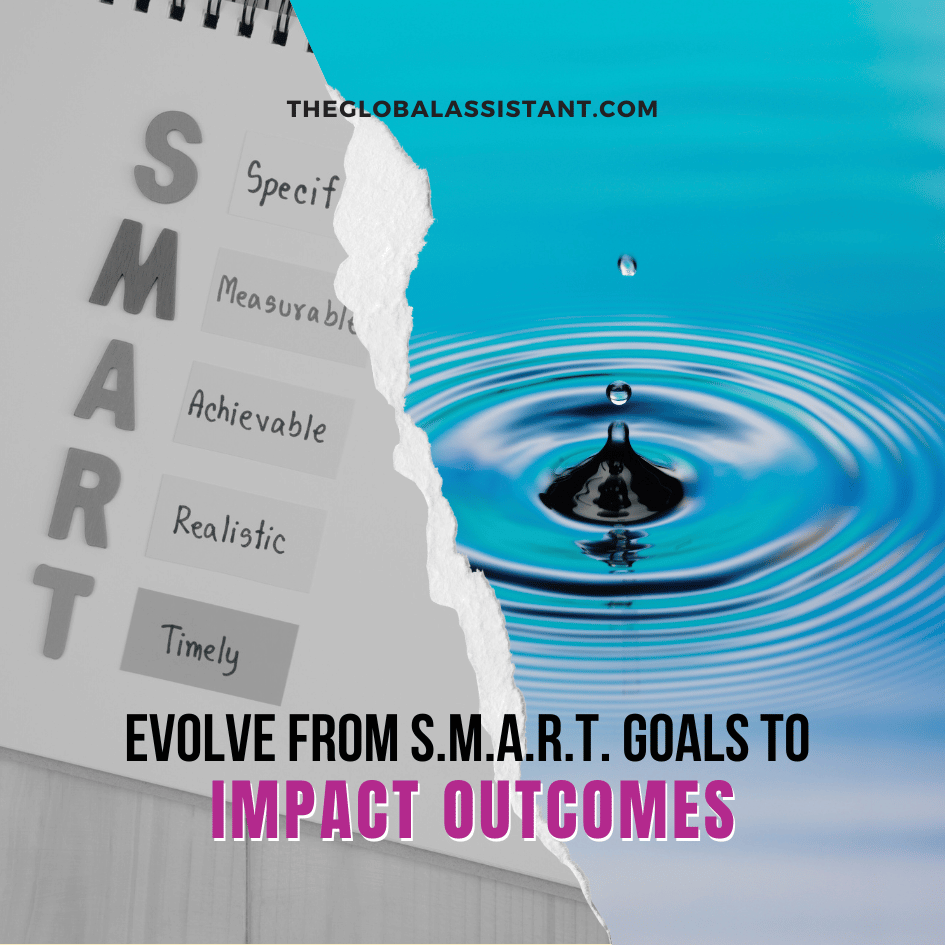
Evolve from S.M.A.R.T. Goals to Impact Outcomes
Note: This article was originally published in 2023 and has been updated to further clarify the concept of “Impact Outcomes” and its relevance in evaluating executive support contribution in today’s operating environment.
The importance of executive support cannot be understated, yet defining meaningful performance measures for these roles has long been a challenge. Traditional performance appraisals often focus on tasks and measurable deliverables, which can overlook the broader contribution executive support professionals make to leadership effectiveness and organizational coordination.
The goal of any performance review is to understand how a role contributes to organizational success. However, assessing the work of executive assistants can be complex. Much of the value created through executive support lies in preparation, coordination, foresight, and relationship management — areas that do not always translate easily into traditional goal-setting frameworks.
While the widely used SMART goals framework (Specific, Measurable, Achievable, Relevant and Time-bound) is effective for many roles, it can struggle to capture the full contribution of executive support work. This is where a shift in thinking becomes useful: moving from measuring tasks alone to considering the broader impact outcomes created through the role.
1. The Limitations of SMART Goals
SMART goals have long been a popular way to structure performance objectives, and they remain valuable for many operational roles. However, their structure can sometimes limit how contribution is evaluated in roles where influence, coordination, and foresight play a significant part. Because SMART goals emphasize measurable outputs, they tend to focus attention on short-term, quantifiable activities. Yet many aspects of executive support generate value through longer-term influence — enabling executives to make better decisions, ensuring stakeholders are aligned, and maintaining organisational flow.
Certain aspects of the work of executive support professionals are difficult to measure or may not fit so neatly into the SMART framework. For example, relationship-building with stakeholders or fostering a positive work environment cannot always be measured in numerical terms. As a result, the SMART framework can be limiting and unhelpful.
2. The Advantages of Impact Outcomes
An alternative way to view executive support performance is through Impact Outcomes — focusing on the organizational effect created by the role rather than simply the tasks completed.
Impact Outcomes considers how the work of executive support professionals strengthens leadership effectiveness, improves decision readiness, and supports coordination across teams and stakeholders. Rather than measuring only what is done, this perspective looks at the broader contribution that results from that work.
For example, preparing a meeting brief is not simply an administrative task. Its real value lies in ensuring that an executive enters a discussion fully prepared to make informed decisions. In the same way, coordinating stakeholders may appear as routine scheduling, yet its impact may be the alignment of key relationships before an important leadership conversation.
3. The Importance of Executive Support
Understanding impact outcomes also requires recognising that executive support roles operate in close partnership with leadership. Executive assistants often operate as a key coordination point within leadership teams, but they need the necessary tools and clear direction to succeed. Collaboration between EAs and executives is essential to align objectives and create a clear path forward. Transparent and open communication can help both parties work towards the same goal and ensure that the EA's impact outcomes are aligned with the organization's overall strategy.
4. Practical Steps Towards Impact Outcomes
Applying an impact-outcomes perspective begins with a shift in how executive support contribution is discussed during performance reviews.
Instead of focusing solely on task completion, conversations can explore how the assistant’s work contributes to leadership effectiveness, decision flow, and stakeholder coordination. Regular dialogue between executives and assistants helps clarify where the greatest impact is being created.
If you need practical language for explaining your contribution in a performance conversation, Beyond the Job Title helps you describe the value of your work beyond a task list.
5. Embracing Change - Moving Forward
Organisations are increasingly recognising that the effectiveness of leadership teams depends not only on the capability of executives themselves, but also on the quality of the support structures around them.
Many of the most valuable contributions made by executive support professionals occur behind the scenes — preparing leaders for complex decisions, coordinating stakeholders, anticipating issues, and ensuring that communication flows effectively across teams.
When performance discussions focus only on tasks completed, much of this contribution remains invisible.
Viewing the role through the lens of Impact Outcomes provides organisations with a more meaningful way to understand how executive support strengthens leadership effectiveness and organisational coordination.
Organisations interested in exploring how an Impact Outcomes approach can be applied to executive support performance and development are welcome to contact The Global Assistant for further discussion.